How Much Money Do I Need to Start Day Trading? (Realistic Capital Guide)
Don't confuse a broker's minimum deposit with the capital you actually need to survive. Discover the realistic cost of day trading in today's market.
Direct verdict: There is a massive gap between the broker minimum required to open an account and the risk minimum required to survive. While you can technically start with a few hundred dollars, sustainable risk management typically requires $5,000 or more to avoid the risk of ruin.
No time to read?
- Legal minimums (e.g., $500) are rarely enough for sustainable risk management.
- The $25,000 PDT rule applies to US margin accounts but can be bypassed via cash accounts or prop firms.
- Professional risk management limits losses to 1-2% of total capital per trade.
- Trading for a living requires a separate 6-12 month living expense reserve.
- Prop firms offer a path to high capital with lower personal financial risk.
How Much Money Do You Actually Need to Start Day Trading?
When asking how much money do i need to start day trading, the answer depends entirely on your definition of “start.” If you mean the absolute legal minimum to execute a trade, the answer is low. If you mean the capital required to build a professional, scalable business without blowing your account in a week, the answer is significantly higher.
The reality is that most beginners confuse a deposit minimum with operating capital. A $500 account allows you to enter the market, but it leaves almost no room for the inevitable learning curve or a standard losing streak. For the majority of traders, $5,000 is the threshold where risk management becomes sustainable, allowing for meaningful position sizes without risking the entire account on a few bad trades.
Before depositing a single dollar, you must audit your financial foundation:
* Emergency Fund: You must have three to six months of living expenses set aside in a liquid savings account.
* Risk Capital: Only deposit money you can afford to lose entirely. Trading with “rent money” creates psychological pressure that leads to catastrophic errors.
* Operating Buffer: Ensure your trading capital is separate from your daily survival funds.
The Pattern Day Trader rule remains the primary regulatory hurdle for those trading U.S. stocks in margin accounts, often making the “realistic” number higher than the “possible” number.
The PDT Rule: Is $25,000 Still Required?
For years, the Pattern Day Trader rule (PDT) has been the most feared regulation for U.S. retail traders. Under this rule, a trader is classified as a PDT if they execute four or more day trades within five business days, provided those trades exceed 6% of their total trading activity for that period. Once flagged, the trader must maintain a minimum equity of $25,000 in their margin account to continue day trading.
Failure to maintain this balance results in the account being restricted, meaning you cannot open new positions until the equity is restored.
$25,000 historical minimum equity requirement for frequent U.S. stock day trading in a margin account.
FINRA
However, the landscape is shifting. A reported 2026 FINRA framework suggests a transition toward a new intraday margin rule. Under this proposed change, the minimum equity requirement could drop to $2,000, depending on the specific rules adopted by individual brokers. While this is a significant reduction, traders must be cautious regarding the implementation timeline. The cited deadline for brokers to fully adopt this new framework is late 2027. This means the $25,000 requirement may persist for several years depending on which broker you use.
This regulatory environment is why many traders debate the merits of a cash account vs margin account. While the margin account offers leverage, it brings the heavy burden of the PDT rule.
Cash Account vs. Margin Account: The Trade-off
Choosing between a cash account and a margin account is a choice between borrowing power and regulatory freedom.
The Cash Account
In a cash account, you are limited to the funds you have actually deposited. There is no leverage, and therefore, no Pattern Day Trader rule to worry about. You can day trade as often as you like, provided you use “settled funds.”
The primary drawback is the settlement period (T+1 for most U.S. equities). If you buy a stock and sell it immediately, those funds are not instantly available to trade again; they must settle first. This creates a liquidity bottleneck that can prevent you from taking high-probability setups if your account is too small.
The Margin Account
A margin account allows you to borrow capital from the broker to increase your buying power. This leverage can amplify profits, but it equally amplifies losses. Because you are trading with borrowed money, brokers must adhere to the PDT regulations to mitigate their own risk.
The danger here is the “maintenance margin.” If your account value drops below a certain threshold, the broker can issue a margin call, forcing you to deposit more funds or liquidate positions at a loss. Effective day trading risk management requires a deep understanding of how much leverage you are applying and the point at which a drawdown becomes a terminal event for the account.
Capital Requirements by Market: Stocks, Forex, Futures, and Options
Different asset classes have vastly different barriers to entry. Your minimum trading capital is often dictated by the contract size or the regulatory environment of the specific market.
- Forex: Extremely accessible due to micro and nano lots. A micro lot (1,000 units) allows for very small risk increments, making it possible to start with as little as $100, though $1,000 to $5,000 is more realistic for growth.
- Futures: Requires capital to cover the “initial margin” for contracts. While some indices offer micro contracts, the volatility requires a larger buffer to survive standard drawdowns.
- Options: Capital requirements vary by “approval level” granted by the broker. Selling options (writing) requires significantly more capital than buying them due to assignment risk.
- Stocks: As discussed, the $25,000 PDT wall is the primary obstacle for active day traders in the U.S.
| Market | Realistic Starting Capital | Primary Capital Barrier | Accessibility |
|---|---|---|---|
| Stocks (Margin) | $25,000+ | PDT Rule | Low |
| Stocks (Cash) | $500 – $5,000 | Settlement (T+1) | Medium |
| Forex | $1,000 – $5,000 | Leverage/Volatility | High |
| Futures | $2,000 – $10,000 | Contract Margins | Medium |
| Options | $5,000 – $10,000 | Approval Levels | Medium |
The Math of Survival: Risk Per Trade and Position Sizing
The most common reason traders fail is not a lack of strategy, but a failure in position sizing. To survive, you must adhere to the 1% to 2% risk-per-trade guideline. This means that if a trade hits your stop-loss, you lose no more than 1% to 2% of your total account equity.
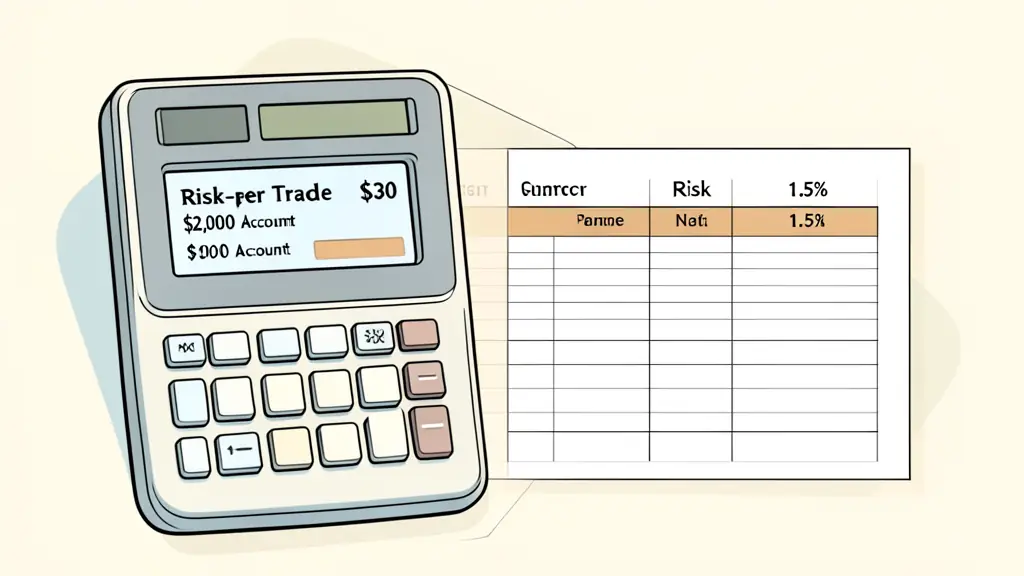
Consider a trader with a $2,000 account. Using a 1% to 2% risk model, they should risk between $20 and $40 per trade.
Worked Example: Calculating Position Size
1. Account Balance: $2,000
2. Risk per Trade (1.5%): $30
3. Entry Price: $50.00
4. Stop-Loss Price: $48.00 (Risk = $2.00 per share)
5. Calculation: $30 (Total Risk) / $2.00 (Risk per share) = 15 shares.
By risking only $30, the trader can endure a long losing streak without facing a catastrophic drawdown. This is the same discipline required for those managing funded trader accounts, where strict drawdown limits are enforced.
$20 to $30 suggested risk per trade for a $2,000 beginner account.
If you risk 10% or 20% per trade, you are not trading; you are gambling. A few consecutive losses will create a “hole” so deep that the percentage gain required to recover becomes mathematically improbable.
Realistic Income Goals: How Much Capital to Make $200 Per Day?
The “make $200 a day” goal is a common trap. To generate $200 daily in profit consistently, you must account for win rate, risk-to-reward ratios, and the crushing weight of taxes.
If you aim for $200 in pre-tax profit, you are looking at approximately $4,000 per month (assuming 20 trading days). However, this is not “take-home” pay. In a scenario where a trader is in a 25% federal tax bracket and a 4.5% state tax rate, they would need to earn approximately $3,600 monthly pre-tax just to break even on basic expenses.
To achieve this without over-leveraging, you cannot rely on a $2,000 account. To make $200 a day while risking only 1% of your account per trade, you would need a massive win rate or a very high risk-to-reward ratio. Realistically, generating a steady income requires a capital base that allows the profit target to be a small percentage of the total account. For example, if you can achieve a conservative 5% monthly return, you would need $4,000 in capital to make $200 a month, but to make $200 a day, the required capital scales into the hundreds of thousands.
Day Trading for a Living: The Professional Capital Buffer
Trading for a living is a business operation, and like any business, it requires operating reserves. The biggest mistake new full-time traders make is using their trading capital to pay their monthly rent. This creates “trading scared” syndrome, where the fear of losing the money needed for survival leads to closing winning trades too early and holding losing trades too long.
A professional capital structure requires two distinct buckets:
1. Trading Capital: The money used to execute trades and manage risk.
2. Living Reserve: A separate cash reserve containing six to 12 months of living expenses.
If your monthly expenses are $2,500, you should have $15,000 to $30,000 in a high-yield savings account before you ever consider quitting your job. This buffer removes the psychological necessity of “winning today,” allowing you to focus on the statistical edge of your strategy rather than your bank balance. Without this, the stress of a drawdown can lead to emotional burnout and a total collapse of trading discipline.
Hidden Costs That Drain Small Accounts
For a trader with $50,000, a $5 commission is negligible. For a trader with $500, it is a significant percentage of their potential profit. These “friction costs” disproportionately impact small accounts and can turn a winning strategy into a losing one.
Key costs to track include:
* Commissions: Flat fees per trade or per share charged by the broker.
* Spreads: The difference between the bid and ask price. In low-liquidity markets, the spread can act as a hidden tax on every entry.
* Slippage: The difference between the expected price of a trade and the price at which the trade is actually executed, common during high volatility.
* Platform Fees: Monthly subscriptions for advanced charting software or direct market access (DMA) feeds.
* Taxes: Short-term capital gains are typically taxed at a higher rate than long-term investments, significantly reducing net profitability.
When these costs are aggregated, a small account may find itself in a “deficit” before the trade even moves in their favor.
The Low-Capital Alternative: Prop Firm Funding
Given the $25,000 PDT barrier and the high capital requirements for sustainable income, many traders are turning to the prop firm model. Instead of risking their own life savings, traders pay a relatively small registration fee to undergo an evaluation. If they pass the firm’s risk and profit targets, they are granted access to a funded account.
The mathematical advantage is clear: instead of risking $25,000 of your own capital to avoid PDT restrictions, you risk a few hundred dollars for the chance to manage $50,000 or $100,000 in buying power. This shifts the risk from your personal net worth to a fixed, one-time fee.
However, this path is not without risks. You must be aware of the hidden costs of cheap prop accounts, such as aggressive drawdown limits or restrictive consistency rules that can lead to account failure even if you are profitable.
Suitability Decision Matrix:
- Less than $2,000 + Low Risk Tolerance: Use a day-trading simulator. Do not risk live capital until you have a documented track record.
- $2,000 to $5,000 + High Discipline: Start with a cash account or a micro-lot Forex account. Focus on the 1% risk rule.
- $25,000+ + Proven Strategy: Open a U.S. margin account for full stock market access.
- Proven Skill + Low Personal Capital: Pursue a prop firm evaluation to scale your earnings without risking personal savings.
Disclaimer: This content is for informational purposes only and does not constitute financial, legal, or professional advice. It is not a substitute for a professional consultation.
This article does not replace advice from a qualified professional: consult a specialist about your own situation.
FAQ
Can I day trade with $500?
Yes, via a cash account or certain forex/CFD brokers. However, your position sizes will be extremely small, and a short losing streak can wipe out a significant percentage of your account.
What happens if my margin account falls below $25,000?
You may be flagged as a Pattern Day Trader (PDT) and restricted from opening new day trades until the balance is restored or the account is converted to a cash account.
How do I calculate my position size?
Divide the dollar amount you are willing to risk (e.g., 1% of account) by the distance between your entry price and your stop-loss price.
Want to go further?
Leave your email and we'll let you know when a new article is out.